Royal College of General Practitioners - Online Learning Environment
Site blog
Written by Dr Toni Hazell
Pneumonia is defined as an infection of the lung tissue, in which the alveoli become filled with micro-organisms, fluid and inflammatory cells, affecting the function of the lungs1. Community acquired pneumonia (CAP) has a mortality rate of around 1% in those who are managed in primary care, rising to up to 14% for those admitted to hospital and to 30% for those who need intensive care1. GPs need to risk stratify and make logical decisions as to who can be managed in the community, and who needs referral and consideration of admission.
An experienced GP will be used to assessing severity of acute infection. We make a clinical assessment, starting with an overall look at the patient (do they look unwell or otherwise make our antennae twitch?), assessment of vital signs such as pulse, respiratory rate, temperature and oxygen saturations, and consideration of co-morbidities such as immunosuppression. The NICE guidance on pneumonia2, published in September 2025, recommends the more formal CRB65 tool, once we have made a clinical diagnosis of pneumonia.
Technology is available to measure C-reactive protein (CRP) as a point of care test in primary care, to help support or refute a diagnosis of inflammation, as occurs in an infection such as pneumonia. A 2016 NICE MedTech innovation briefing3 noted that primary care CRP testing can reduce antibiotic prescribing and referrals for chest x-ray, but that the sensitivity did not rise above 55% (and could be as low as 20% depending on the threshold used). Specificity was better, ranging from 73 – 99%. In the nine years since that briefing, the test has not become widely available, with barriers including cost, lack of commissioning enthusiasm and concern about the evidence base for effectiveness and value for money. A 2025 qualitative review4 comparing the UK with Sweden, the Netherlands and Canada, found that uptake of primary care CRP testing was higher in the other countries, but that clinicians didn’t feel that it had made a huge improvement to their assessment of patients with possible pneumonia, with some saying that the introduction was a policy failure, and the test over-used. Other studies have shown that CRP use is associated with increased antibiotic prescribing, rather than helping to reassure that antibiotics aren’t needed, and that this is particularly associated with systems where a CRP is checked before the patient is seen, resulting potentially in spurious high results in those with a low pre-test probability of bacterial infection5. NICE does not discuss primary care CRP in its latest guideline2, but where it is being used the Primary Care Respiratory Society suggests cut-offs of 20 and 40 mg/L – do not prescribe antibiotics with CRP<20, consider prescribing with CRP of 20-40 if there is purulent sputum, and prescribe with CRP>406.
The CRB65 scoring system is outlined in the box below and the results predict the risk of death in the next 30 days. Zero is low risk (<1%), 1 or 2 intermediate risk (1 – 10%) and 3 or 4 high risk (>10%).
CRB65 score – one point for each of the following:
- Confusion (new disorientation in person, place or time, or a score of ≤8 on an abbreviated mental test).
- Respiratory rate ≥30.
- Blood pressure ≤60 mmHg diastolic or 90 mmHg systolic.
- Age ≥65.
NICE write ‘guidelines not tramlines’7, and this guideline acknowledges the holistic nature of our assessment, advising the use of clinical judgment along with the CRB65 score, which can be affected by other factors such as comorbidities or pregnancy. NICE advises considering referral with a CRB65 score ≥2, and that those with a CRB65 score of 1 might benefit from an assessment in a same-day emergency care unit (which is in any case often where those referred to hospital will end up) or by being referred to a virtual ward or hospital at home service. Those with a score of zero can be managed in primary care, with appropriate safety-netting to return if symptoms deteriorate. Any signs of significant complications, such as heart failure, would lower the threshold for referral. We should have a lower threshold for children and young people (those aged under 18), considering referral or specialist advice for every patient.
For those not admitted, we would usually treat pneumonia with antibiotics in the community, to be started as soon as possible after the clinical diagnosis has been made2. Whilst some causes are viral, the majority of pneumonia has a bacterial cause1, and we cannot reliably differentiate between the two. The commonest bacterial cause is Streptococcus pneumoniae, with other responsible organisms including Haemophilus influenzae, Staphylococcus aureus and the atypical Mycoplasma pneumoniae. Those who are immunocompromised, or who have had multiple recent courses of antibiotics, may be more likely to have an unusual or drug-resistant bacteria (or a fungal infection such as Aspergillus) as a cause for their pneumonia8,9; pneumonia in those with an unsafe swallow may be related to aspiration of stomach contents10.
NICE emphasises the need for only a five day course of antibiotics for adults and three days for children aged up to 11, with a longer duration only when clinically necessary. This may be because they have had a temperature in the last 48 hours of the five day course, or that they continue to have a sign of clinical instability, such as (in adults) systolic blood pressure <90 mmHg, heart rate >100 bpm, respiratory rate >24 breaths per minute or oxygen saturations <90% on air. These parameters, if present after five days of antibiotics, might make us re-visit the decision to keep the patient at home. The suggested first-line antibiotic for low-severity disease is amoxicillin, with doxycycline or clarithromycin as second-line, and erythromycin for pregnant women. For moderate severity disease the choice is largely the same, although clarithromycin moves to first line if an atypical bacterial cause is suspected. Those with high-severity disease are likely to be in hospital, but if treated in the community then a combination of co-amoxiclav and clarithromycin are first line, with erythromycin in pregnancy and levofloxacin as an alternative for those with penicillin allergy (bearing in mind the MHRA advice on quinolones11).
Distinguishing between typical and atypical bacterial causes without a sputum sample is by no means an exact science; those with an atypical bacteria may have more prolonged or prominent constitutional symptoms (headache, malaise, sore throat, fever) and may be less likely to have clear consolidation on auscultation of the chest. Atypical infection can come in epidemics, with many cases clustered together and then none for several years and is more common with increasing age and in those who live in enclosed spaces such as boarding schools or military barracks. Outbreaks of one particular atypical bacteria, Legionella pneumophila are associated with contaminated water and air-conditioning systems and another, Legionalla longbeachae is associated with exposure to contaminated soil mixtures12. Consideration of an atypical bacteria should be given when the patient doesn’t respond to an apparently appropriate first-line choice of antibiotic, and where there is a history of staying in a hotel or resort where exposure may be more likely.
Further reading and useful resources
- RCGP eLearning modules on Aspergillus and pneumonia.
- NICE guidance on pneumonia.
- StatPearls articles on aspiration pneumonia, atypical pneumonia and pneumonia in the immunocompromised patient.
- Patient information leaflet and NHS webpage on pneumonia.
References
- NICE CKS. Chest infections – adult. Jan 2025.
- NICE. NG250. Pneumonia: diagnosis and management. Sept 2025.
- NICE. MIB81. Alere Afinion CRP for C-reactive protein testing in primary care. Sept 2016.
- Glover RE, Pacho A, Mays N. C-reactive protein diagnostic test uptake in primary care: a qualitative study of the UK's 2019-2024 AMR National Action Plan and lessons learnt from Sweden, the Netherlands and British Columbia. BMJ Open. 2025 Aug 31;15(8):e095059.
- Payne R, Mills S, Wilkinson C et al. Point-of-care C-reactive protein testing in general practice out-of-hours services: tool or trap? Br J Gen Pract. 2025 Aug 28;75(758):388-389.
- Primary Care Respiratory Society. The place of point of care testing for C-reactive protein in the community care of respiratory tract infections. Summer 2022.
- Reeve J. Avoiding harm: Tackling problematic polypharmacy through strengthening expert generalist practice. Br J Clin Pharmacol. 2021 Jan;87(1):76-83.
- Aleem MS, Sexton R, Akella J. Pneumonia in an Immunocompromised Patient. [Updated 2023 Jul 25]. In: StatPearls [Internet]. Treasure Island (FL): StatPearls Publishing; 2025.
- Assefa M. Multi-drug resistant gram-negative bacterial pneumonia: etiology, risk factors, and drug resistance patterns. Pneumonia (Nathan). 2022 May 5;14(1):4.
- Sanivarapu RR, Vaqar S, Gibson J. Aspiration Pneumonia. [Updated 2024 Mar 20]. In: StatPearls [Internet]. Treasure Island (FL): StatPearls Publishing; 2025 Jan-.
- MHRA. Fluoroquinolone antibiotics: must now only be prescribed when other commonly recommended antibiotics are inappropriate. Jan 2024.
- Nguyen AD, Stamm DR, Stankewicz HA. Atypical Bacterial Pneumonia. [Updated 2025 Apr 6]. In: StatPearls [Internet]. Treasure Island (FL): StatPearls Publishing; 2025 Jan-.
An NIHR GM PSTRC (NIHR Greater Manchester Patient Safety Translational Research Centre) funded free e-learning course which has been accessed by 7000 prescribers since 2014 has undergone an evaluation and been re-launched with the addition of new content.
Dr Richard Knox from the University of Nottingham is one of the researchers who has worked on the e-learning course, Prescribing in General Practice. He talks about the impact of the course and the new updates here:
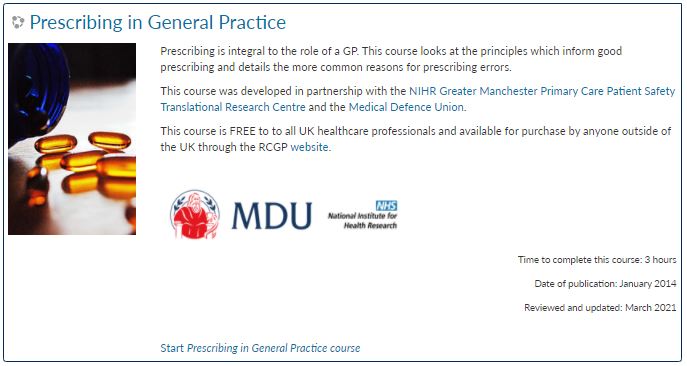
Prescribing in General Practice is an e-learning course, hosted on the Royal College of General Practitioners’ (RCGP’s) e-learning platform. It’s a case-based approach designed by prescribers so there’s a focus on real life examples. It was launched in 2014 and has recently undergone revisions from people who use it to ensure all the real-life examples that are used meet current guidelines. The course was also evaluated by researchers at the GM PSTRC in a new paper, which has been published in the journal Education for Primary Care.
To help assess the course’s success, in the paper, researchers used the results of a questionnaire completed by those who finished the e-learning modules. According to this the course had a positive impact on knowledge, skills and attitudes. More than 98% of 750 survey responders said the course had been a useful part of their continuing professional development.
Those who responded also wrote additional feedback and some examples are below:
“This module comprehensively covered contemporary prescribing issues particularly with respect to safety. It was grounded in everyday practice and informed by real life examples of prescribing errors and how they may occur and how to mitigate against them at an individual and at a systems level.”
“Usefully it was from the RCGP so the majority of medicines and cases presented were similar to what I would encounter on a daily basis in work. I feel from completing this module my safety and efficiency in prescribing will improve.”
“This course is going to change/improve many aspects of my prescribing practice. I would definitely spend more time on writing clear instructions for patient.”
The course was initially developed to facilitate safer prescribing among GPs. However, funding from the GM PSTRC has enabled the course to be free-to-use for all prescribers, regardless of professional background. This has increased the impact of the course which improves the safety of prescribing more widely.
The original idea for the e-learning materials came as a direct result of findings from the General Medical Council’s PRACtICe study. This was a large study of prescribing errors in UK general practice, which revealed that about one in twenty prescriptions from primary care contains an error. The PRACtICe study included a root cause analysis that helped establish a set of recommended strategies that may improve prescribing. The need to invest further in education and training was identified by all GPs, whatever their stage or experience of prescribing. A series of focus groups made up of GP trainers, GPs in training, pharmacists and members of the public also confirmed support for further training to be made available. The value of e-learning was championed – with stakeholders requesting a strong case-based approach to help inform real-world practice.
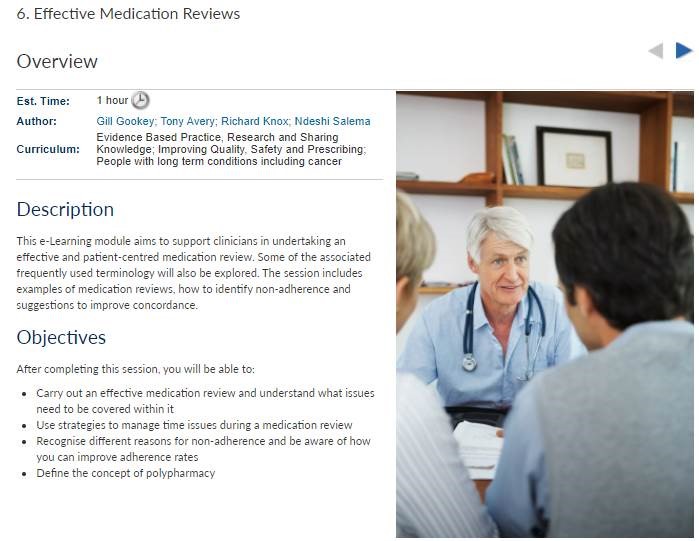
The e-learning includes five distinct lessons, each taking about thirty minutes to complete:
- Lesson one – Appropriate drug selection
- Lesson two – Avoiding prescribing errors
- Lesson three – Choosing the right drug
- Lesson four – Right dose instructions
- Lesson five – Effective medication reviews
Due to the updates the course now includes specific sections on topics such as prescribing multiple medications for the same person at the same time (polypharmacy) and the use of the Seven Step medication review process.
Please note, this course is now RCGP Members' benefit. Non-members have an option to purchase the course. You can access the Prescribing in General Practice course here.